Aquatic Lands: Floods, Wetland Drainage, and Protest in Early Modern England

Natalie Zwätz

28.09.26

Natalie Zwätz is a Lecturer and PhD student in the Department of Literature, Art and Media Studies, University of Konstanz

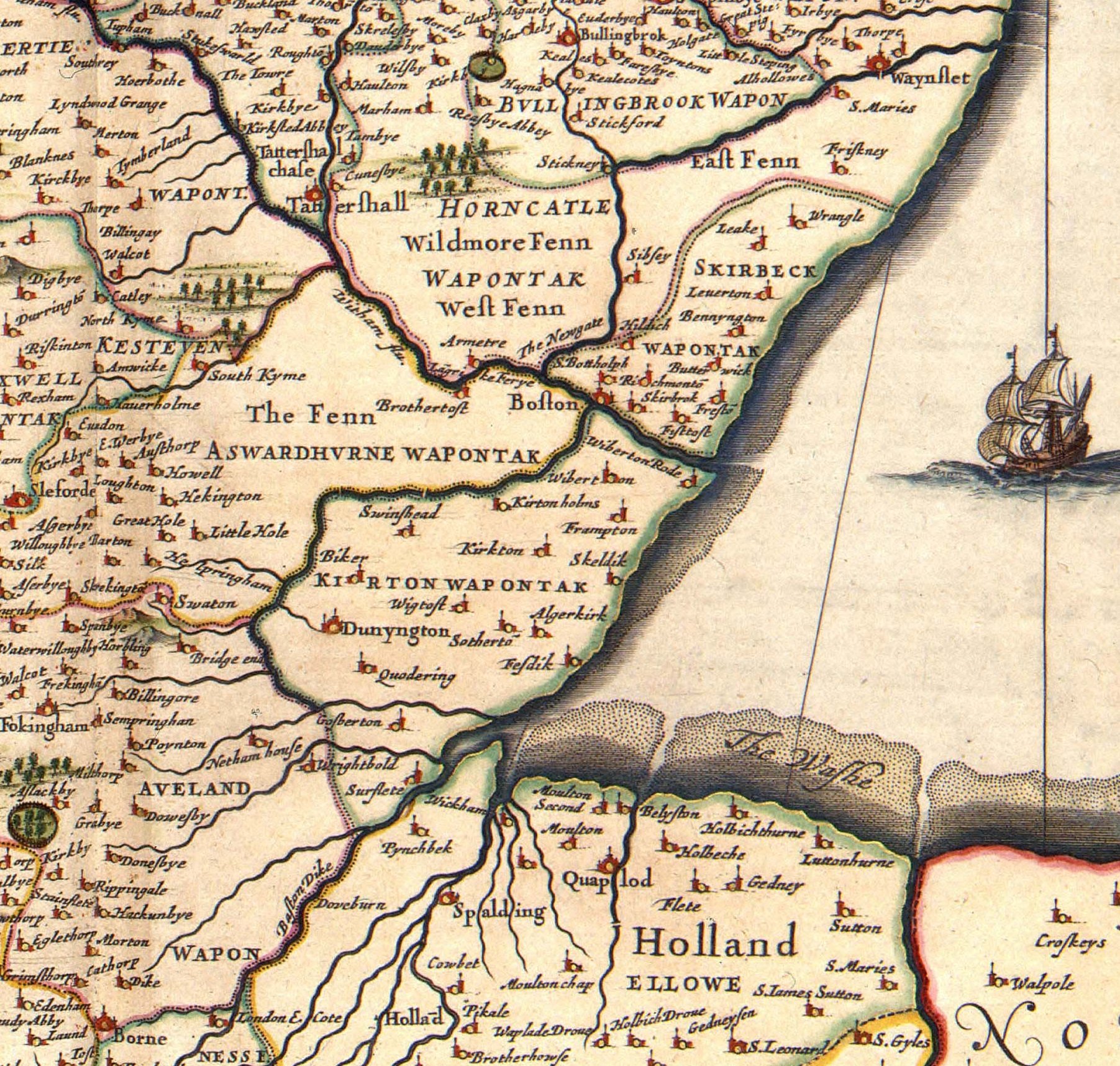
Jan Janssonius, Detail of the Fens from a map of Lincolnshire (mid-seveteenth Century) (Public Domain)

In a year of extreme heat and drought across Europe, Natalie Zwätz writes on what the history of the Fens and its early modern poetry can tell us about the relationship between people and environment.

In 2026, Western Europe experienced its hottest June and July since weather records began. The five record-breaking heat waves alongside an exceptional lack of rainfall during most of the summer months had severe consequences, especially in France, Spain, Germany, and the UK (see “Copernicus”, NASA Earth Observatory). The vivid images of dry riverbeds, yellow stretches of grassland, and dried-up soil, and the high number of seemingly uncontrollable wildfires made it apparent that the climate crisis has arrived at our doorstep.[i]

While the risk of extreme weather like this is constantly increasing due to anthropogenic climate change, over the last centuries, humans have also largely destroyed important water reservoirs and natural barriers against wildfires – wetlands. A recent study has shown that since 1700, the Earth has lost roughly 3,4 million km² of wetlands. This has made wetlands one of the “most threatened ecosystems in the world”, with negative effects on water storage, carbon balance, groundwater levels, and biodiversity (Fluet-Chouinard et al. 281). In the face of the looming climate catastrophe, it is therefore useful to reconsider the relationship between humans and the boggy spaces between water and land that could increase resilience against environmental crises.

The loss of now almost 90% of Britain’s wetlands reached its first peak during the sixteenth and seventeenth centuries, when large areas of the east English Fen region were set up to be drained and turned into arable land. This region, made up of peat fens and silt marshes along a large bay of the North Sea called The Wash, is a landscape thoroughly defined by water and the ocean. The area used to be part of the North Sea floor, and large stretches of the Fens are only a few metres above sea level now. Through regular floods, glacier ice movement and silt deposits from the marine tides, the contemporary Fens, with their meandering rivers and few higher-lying isles, were created and shaped through the movement of water in various forms.

Despite their challenging geography, the region has a long history of successful settlement since the Iron Age (from about 700 BC). By the sixteenth century, the population of the Fens had adapted to the unique living situation on the marshland and established a productive local economy based on the seasonal usage of the fields, fowling, fishing, and animal husbandry on the shared common land. Floods from both the upland rivers and the ocean nearby contributed to the fertility of the soil and were utilised to increase agricultural yields, fed the habitat for dozens of species of fish and waterfowl, and provided water for the lush surrounding grassland.

However, this closeness to the ocean, the uncertainty created by the tides and seasonal floods, and the close connection to and usage of the liminality of the landscape was perceived as strange and uncivilised by outsiders. A seventeenth-century traveller defined the Fens as “an equilibrian plantation of earth & water […] in an unhealthful, raw, & muddy land”, and thinks the Fenlanders to “be half fish, half flesh, for they drink like fishes, & sleep like hogs” (“A Relation of a Short Survey of the Westerne Counties”, 1635).[ii]

Narratives like these invoke a clear distinction between water and land that is dissolved in the liminal wetlands. Humans are portrayed as inextricably linked to their environment; so much so that they themselves adopt this liminal status and become a strange mixture of fish and hog, water and earth. H.C.’s Discovrse on the potential draining of the region similarly negotiates the opposition of  “a wilderness of water & a goodly green meadow” (B2), with the latter being the favourable landscape. These outside descriptions contributed to a shift in the cultural perception of the Fens, which now appeared to be “an embarrassment to a civilized state” (Ash 8) and needed to be tamed and cultivated.

The climatic shift of the Little Ice Age and the resulting food shortages, rising sea levels, and more severe storms (see Ash 44) added to this understanding of the Fens as a seemingly underdeveloped and unproductive region. Developers who were searching for opportunities to create more arable land thus began to set their sights on the East English wetlands. Eventually, after a period of especially severe flooding in the years 1570 to 1600, the Crown was presented with the earliest proposals to drain the Fens.

One of the most striking instances of literature dealing with the ensuing drainage project is the anonymous protest poem “The Powte’s Complaint”. First published in William Dugdale’s 1662 The History of Imbanking and Drayning of Divers Fenns and Marshes, but most likely written around 1611, the poem is introduced as one of the “libelous songs to disparage the work of drainage” produced for “the opposition which divers perverse spirited people made thereto” (Dugdale 391).

The complaint fittingly opens with a summons for a public meeting: “Come Brethren of the water, and let us all assemble / To treat upon this matter, which makes us quake and tremble” (1-2). What starts as a call to civil disobedience, however, quickly turns more violent by pleading to the goddess Ceres to “let frogs and miry bogs destroy where they [the projectors] do enter” (7-8). Three stanzas later, the speaker then incites direct violent action by proclaiming that the humans and animals of the Fens “must give place (oh grievous case) to horned beasts and cattle / Except that [they] can all agree to drive them out by battle” (19-20). These three excerpts prominently illustrate the role of water in the poem and for the protesting population of the Fens. The audience is addressed as “brethren of the water”, “miry bogs” are perceived as accomplices in the fight against the projectors, and land animals like cattle are the opposition to the watery brotherhood. This is further highlighted by the speaker of the poem, the titular powte. The exact species of fish cannot be ascertained without doubt, but Borlik and Egan point to the burbot, which died out in the twentieth century because of the fen drainage, as the most promising candidate (258-9).

This defining connection between water and people is also embedded in the folklore of the region, in which the Fen population and water or water-related deities share alliances and defend the Fens against foreign foes. According to a popular origin story, the region was once populated by giants and elemental deities. To save the daughter of the giant’s chief from the Fire Spirit, the Water God instructed the giants to dig the first dyke of the Fens. Once the Fire, aided by the Tempest, attacked the giants, they opened up the dyke, creating a “broad shining channel [that] barred the fire-god’s path” while “from the safety of the barricade, the giants watched the defeat of their enemies” (Marlowe 5). After their win, the giants swore fealty to the Water God and to maintain the barrier between his people and the dangers on the other side. Another myth features a storm surge as protector of the ancient Fenland people against the Roman invaders. According to the legend, the enslaved Fenlanders received a divine warning about an incoming flood and fled towards the hills, while a “mountain of water” that “seemed as if all the ocean were gathered up into it” (Marlowe 14) destroyed the Roman settlement. In the area “where had formerly stood an almost impenetrable forest there now appeared a vast inland sea, dotted here and there with islands” (Marlowe 15), which would, from now on, protect the Fen people from invaders.[iii]

As these, amongst many similar water-related myths of the Fen region, illustrate, the land and its people are inseparably linked to the sea and water. “The Powte’s Complaint” invokes these ancient myths by calling to the “water Nurses” (21), “Captain Flood” (23), the “God Eolus” (29), and “Great Neptune (God of Seas)” (33) to aid the Fenland people in their battle against the draining projectors. The powte asks the water Nurses to “send us good old Captain Flood to lead us out to battle” (23), resurrecting the mythological companionship. By claiming that “All will be dry, and we must die cause Essex calves want pasture” (12), the protest song further draws a direct connection between the enclosure of wetlands for cattle farming and the death of the inhabitants of this ecosystem. Throughout, water is therefore not associated with danger; lines like these rather make the oppositional claim that drought is the real threat for this ecosystem. In a later call to Neptune to “send [his] Sands to make dry lands when they shall want fresh water” (36), this is even more prominently voiced. The God of the Sea is here not only the master of water but also of sand, which, in the form of a beach, is a liminal space between wet and dry, land and ocean, very similar to the Fens. In the closing line of the poem, the speaker returns to the familiar theme of the flood by praying to the moon as the controller of the tides to “be so good as send a flood lest Essex Calves want water” (40). “The Powte’s Complaint” thus closes with a sarcastic plea and the implication that, despite the projector’s goal to tame and ultimately remove the element that defines the Fens, there can be no life without water.

Read in the wake of this year's devastating hot and dry summer, this early modern protest poem seems to anticipate the severe consequences of anthropogenic intervention in complex ecosystems. In our contemporary climate crisis, liminal spaces like the Fens are some of the most important resources for climate resilience, and their history becomes a testament to the value of close entanglements between humans and their environment.

An important contribution in the fight against climate change and its devastating effects is thus the restoration of destroyed wetlands and the protection of the few that are still intact. As Christian Dunn argues, “[w]e cannot make Britain fireproof. But by restoring wetlands, we can make them more fire-resilient” (Dunn). Following the events of the summer of 2026, this endeavour is more urgent than ever.

[i] In England and Wales, firefighters had to respond to 185 wildfires in the first ten days of August alone, and July has been the busiest month on record with more than 450 wildfires (Franklin).

[ii] The spelling of the quoted material has been modernised to increase readability.

[iii] James Boyce points out that the so-called ‘bog oaks’, trees preserved in the peat of the Fens “do face the same way” (8), implicating that this legend is based on an actual flood storm or tidal wave that flattened the region.

Works cited:

“A Relation of a Short Survey of the Westerne Counties, in Which Is Briefely Described the Citties, Corporations, Castles, and Some Other Remarkables in Them. Observ’d in a Seven Weekes Journey Begun at Norwich, & Thence into the West. On Thursday August 4th 1635 and Ending att the Same Place. By the Same Lieutennant, That with the Captaine, and Ancient of the Military Company in Norwich Made a Journey into the North the Yeere Before.” London, 1635.

Boyce, James. Imperial Mud: The Fight for the Fens. Icon Books, 2020.

“Copernicus: Record Heatwave Brings Hottest June for Western Europe during Second-Warmest June Globally.” Copernicus, 9 July 2020, https://climate.copernicus.eu/copernicus-record-heatwave-brings-hottest-june-western-europe-during-second-warmest-june-globally. Accessed 16 Sept. 2026.

Dugdale, William. The History of Imbanking and Drayning of Divers Fenns and Marfhes, Both in Forein Parts and in the Kingdome and of the Improvements thereby. London, 1662.

‌Dunn, Christian. “Over 75% of UK Wetlands Have Been Destroyed – Restoring Them Would Help Prevent Wildfires.” The Conversation, Aug. 2026, https://doi.org/10.64628/ab.mjgux9n9m. Accessed 15 Sept. 2026.

Franklin, Amelia. “Fire Chiefs Warn of Sustained Wildfire Pressures as Drought Spreads across England and Wales.” NFCC, 11 Aug. 2026, https://nfcc.org.uk/fire-chiefs-warn-of-sustained-wildfire-pressures-as-drought-spreads-across-england-and-wales/. Accessed 21 Aug. 2026.

Fluet-Chouinard, Etienne, et al. “Extensive Global Wetland Loss over the Past Three Centuries.” Nature, Vol. 614, 2023, pp. 281-6.

H.C. A Discovrse Concerning the Drayning of the Fennes and Svrruvnded Grovnds in the fixe Counteys of Norfolke, Suffolke, Cambridge with the Ifle of Ely, Huntington, Northhampton, and Lincolne. London, 1629.

Marlowe, Christopher. Legends of the Fenland People. C. Palmer, 1926.

NASA Earth Observatory. “Europe’s Scorching Summer.” NASA, 21 Aug. 2026, https://science.nasa.gov/earth/europes-scorching-summer/. Accessed 16 Sept. 2026.