
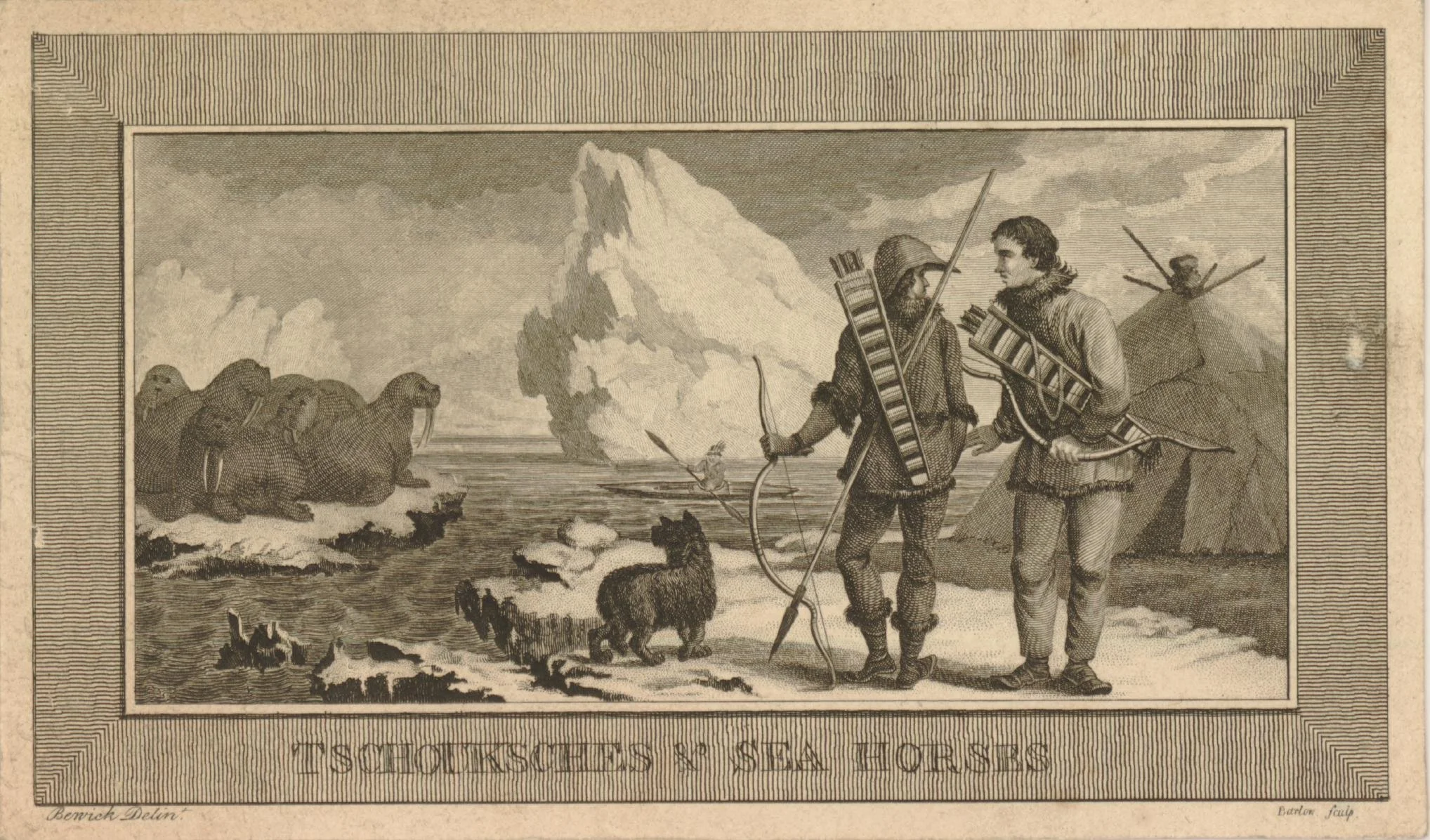
Sea ice as a barrier and an enabler: Captain Cook´s relationship with nonhuman materialities
Reetta Sippola
Sippola is a doctoral candidate in Cultural History at the University of Turku.
© The Trustees of the British Museum. Shared under a Creative Commons Attribution-NonCommercial-ShareAlike 4.0 International (CC BY-NC-SA 4.0) licence.
In April, BSSI invited Reetta Sippola to contribute to its piece on sea ice.
My upcoming PhD research on material agency in the Arctic and James Cook’s third voyage (1776–1780) aligns with the aspirations of the Blue Sustainability and Society Initiative (BSSI) to explore how humans have perceived, used, and valued the ocean. One way to analyse this is to view sea ice through material agency and position the ocean as a central and active participant in human history and culture. Sea ice should be treated as a nonhuman actor that humans interact with in embodied ways.
Sea ice is constantly changing by freezing, thawing, currents, and winds. During Captain Cook´s search for the Northwest Passage in the Arctic waters in the summer seasons of 1778 and 1779, the movement and survival strategies of the expedition depended on these changes. Ice offered opportunities, such as melting icebergs for freshwater, which was easier than transporting water barrels to the shore. The ships could be anchored or moored to the ice to fix a leak that occurred by the freezing water or hitting of an iceberg, but conditions could change quickly. Ice closed passages that were open only yesterday, and navigation depended not only on skill but on the shifting behaviour of ice floes.
Ice as a material force placed restrictions on human agency. Whilst fog and ice reduced manoeuvrability and obscured the shoreline, or humidity and temperature altered the observing instruments, scientific observations became limited. Ice influenced how long crews could remain in a region and when they could hunt for walruses on the ice’s edge. Cook responded by searching for an opening, drafting at least a provisional charting of the shoreline, and by eventually ordering the ships to turn back after facing a wide ice wall at the end of the season.
Philosopher Jane Bennett’s concept of ‘thing-agency’ is advantageous for highlighting how materialities possess capacities that shape human action. It refers to the capacity of nonhuman matter to act, affect, and participate in events. Bennett has reconsidered the typical western view on material relationships in her book Vibrant matter: A political ecology of things (2010), claiming that it is important to consider that ‘things’ do not merely influence humans (or objects), because some change always takes place in both parties: it can be a chemical rearranging due to freezing or thawing, or perhaps a reaction such as the walruses rushing to the sea when attacked by the loud muskets of the explorers. Any ‘thing’ can initiate a chain of events that also influence humans; and if something disappears from the ecological chain, it is unsure how the world turns out.
If we allow ourselves to see agential properties in materiality, the historical record constantly demonstrates how sea ice, currents, weather, and animal life constantly shaped what humans could do, and that Cook’s exploration of the ocean and its shorelines was a negotiation with these powerful material forces. For the crews navigating the dynamic and unpredictable environments, survival depended not simply on technology or weapons, but on learning to read the material world around them. Learning embodied techniques to sound and understand the changes of sea ice, such as observing its colour, movement, sounds, and the direction of winds and currents helped the explorers to keep working in the Arctic conditions.

■