
Isabel Realyvasquez
Realyvasquez is a PhD candidate in the Department of English and Comparative Literature at Columbia University.
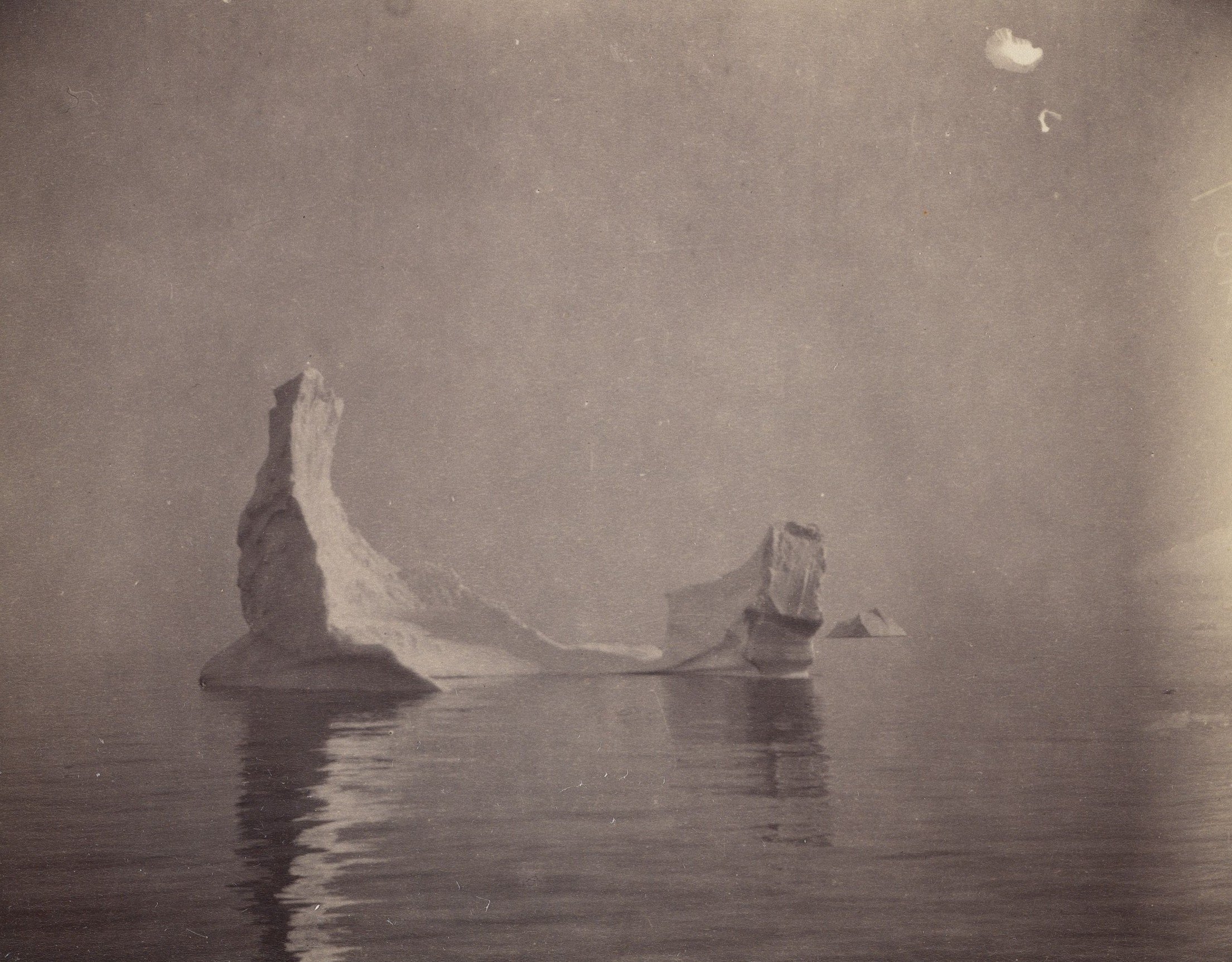
Robert E. Peary, “Icebergs” (1893-95). The Metropolitan Museum of Art.
In April, BSSI invited Isabel Realyvasquez to contribute to its issue on sea ice.
Though Captain James Cook’s name is etched across the world’s maps as a testament to imperial discovery, the sea ice of the Southern Ocean, which he encountered on his second voyage (1772-1775), interrupted this cartographic authority, leaving Terra Australis Incognita stubbornly unknown. Rather than a narrative of triumphant exploration, my research considers how Cook’s journals linger over what he calls “islands of ice”: drifting, mutable fragments that repeatedly block his passage, crowd and stall his ship, and ultimately force him to abandon the search for Antarctica. These ice islands resist more than navigation; they intrude upon and unsettle the Enlightenment subject’s claims to knowledge and control.
Cook’s polar encounters illuminate the psychological and material force sea ice exerted on the colonial mind: a force that becomes all the more striking when juxtaposed with the rapid disintegration of Earth’s cryosphere today. Although Cook failed to find Antarctica, his voyages nonetheless set in motion processes of globalization that have made the polar regions intimately legible through their catastrophic melting. What he once described as a region “doomed by Nature” to “lie for ever buried under everlasting snow and ice” now bears the ominous name of the “Doomsday Glacier,” while the ice-choked Northwest Passage he later sought in the Arctic has become a heavily trafficked shipping route.
My work, however, is not only concerned with this narrative of inevitable loss. I am interested in how islands of ice open alternative ways of thinking about ecological relation and unsettle Enlightenment ideas of progress and rigid distinctions between the human and nonhuman. I take cue from Michel Serres’s metaphor of the Northwest Passage as an opening rather than an obstacle, an invitation to think beyond settled divisions and toward other ecological philosophies: “the passage resembles a jagged shore, sprinkled with ice, and variable . . . It’s more fractal than simple. Less a juncture under control than an adventure to be had.” I take up this journey to explore the epistemologies revealed through Cook’s encounters with polar drift, a path that has led me from European archives to Indigenous cosmologies at the southern edge of the world.
I place Cook’s journals in dialogue with stories from the Yagan of Patagonia—whose traditional lands stretch from Tierra del Fuego to Cape Horn—as recorded by Cristina Zárraga from narratives passed down by Cristina and Úrsula Calderón. In the story “Taún,” ice appears not as inert matter or data, but as something approached with attentiveness and care. That is, as a being endowed with personhood. Describing an iceberg washed ashore, Calderón recounts hearing voices from within the ice: “there were people inside it speaking; it sounded like they were cutting firewood with an axe.” Where Cook encounters sea ice as a threat to navigation and Enlightenment subjectivity, the Yagan account emphasizes proximity, listening, and respect.
Bringing these different perspectives into dialogue does not resolve the violence of colonial erasure or the disproportionate vulnerability Indigenous communities face in a warming world. It does, however, reorient polar ice not merely as a site of catastrophe, but as a medium through which alternative ecological relations become thinkable. Global ice melt does not simply mark an ending; it invites us to reimagine the shifting, entangled relations between humans and nonhumans that arise in its wake.
—-
Further Reading:
Cristina Zarraga, Hai Kur Mamášu Čis: I Want to Tell You a Story. Translated by Jacqueline Windh. Ediciones Pix, 2013.
Olivier Remaud, Thinking like an Iceberg. Translated by Stephen Muecke. Polity, 2022.
Michel Serres, Conversations on Science, Culture, and Time with Bruno Latour. Translated by Roxanne Lapidus. The University of Michigan Press, 1995.
Jenn Rose Smith, Ice Geographies: The Colonial Politics of Race and Indigeneity in the Arctic. Duke University Press, 2025.
■